
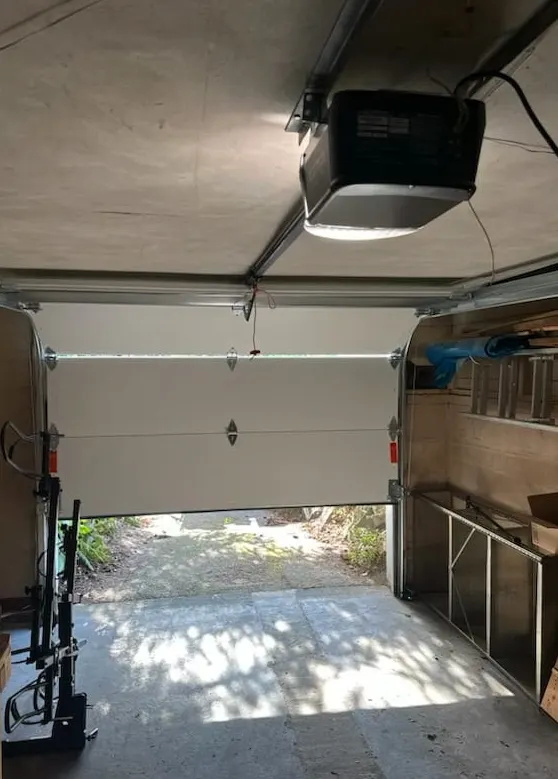
The first thing most people do after losing a garage door remote is drive to the hardware store, buy a replacement, and program it to work alongside everything else already in memory. It feels like the fast fix: no ladders, no digging through the owner's manual, no risk of accidentally wiping the keypad code your dog walker uses. The problem is that this leaves the lost remote fully active. If it fell out of a golf cart on Pine Avenue or walked off with someone who shouldn't have it, that person can still open your garage until you erase the opener's entire memory and start over. Adding a new remote without clearing the old ones solves the inconvenience but not the security problem.
Tools You'll Need
- Stepladder (most opener units are mounted on the garage ceiling)
- Your opener's brand and model number (usually on a sticker on the motor housing)
- Owner's manual or the manual's PDF, if you can find the model online
- Fresh batteries for remotes and the keypad
- A small screwdriver for keypad battery covers
- Dielectric grease or electronics contact cleaner (helpful near the coast)
Step-by-Step: Clearing Old Codes and Reprogramming
- Find the Learn button. On most openers made in the last 20 years, it's a small purple, orange, or green button near the antenna wire on the motor unit. Pressing and holding it (usually 6-10 seconds) until the indicator light turns off erases every remote and keypad code stored in memory. This is the step people skip, and it's the one that actually removes a lost remote's access.
- Confirm the wipe. Try the old remote. If the door doesn't respond, the memory is clear and you're starting fresh.
- Reprogram the wall keypad first. Enter a new 4-digit PIN at the keypad, then press and hold the Learn button on the motor unit, then enter the PIN on the keypad within 30 seconds. A click or light flash confirms it's learned.
- Program each remote one at a time. Press Learn on the motor unit, then press the button on the remote within 30 seconds. Repeat for every remote and every vehicle's built-in garage door button separately — they don't share a code, so each one needs its own trip up the ladder.
- Test from outside and inside. Walk the full range you'd normally use (driveway, street, car) to confirm every device works before you put the ladder away.
- Label and store spares. If you keep a backup remote in a kitchen drawer, label it with tape so the next person who loses one knows there's already a working spare instead of ordering another.
What a Homeowner Can Handle
- Erasing and reprogramming remotes and keypads using the Learn button
- Changing a keypad PIN after a house sitter, contractor, or renter no longer needs access
- Replacing keypad and remote batteries, including corroded battery contacts
- Basic troubleshooting, like a remote that only works up close (usually a weak battery or a cracked antenna wire at the motor)
What Needs a Technician
- The Learn button doesn't respond, doesn't light up, or won't hold a new code — this often points to a failing circuit board, not user error
- An older opener that uses physical dip switches instead of a digital rolling code; these are harder to secure and are a common reason to upgrade
- A keypad that's been open to salt air for years and has visibly corroded contacts inside the housing, even after a battery change
- Repeated reprogram failures across multiple remotes, which usually means the receiver inside the opener itself is going bad, not the remotes
- Wiring damage to a wall console, especially after any water intrusion from storm season
Why the Coast Makes This More Than a Convenience Issue
Keypads mounted outside near Anna Maria Island take a beating that inland units don't. Salt air corrodes battery contacts and internal springs faster than most people expect, and humidity causes battery compartments to swell and stick shut. If your keypad buttons have gone unresponsive or sticky, that's often corrosion rather than a dead battery, and it's worth checking before you assume the whole unit needs replacing. A keypad with a working weatherproof cover, kept closed between uses, will hold up far longer in this climate than one left exposed to afternoon downpours all summer.
When to Call Anna Maria Garage Door Service
If you've erased the memory, tried a fresh Learn-button cycle, and the opener still won't accept a new code, that's usually an electronics problem inside the unit rather than something a new remote will fix. We'll diagnose whether it's the receiver, the logic board, or wiring, and if the opener is old enough that parts are no longer reliable, we'll talk through Garage Door Opener Installation options built for coastal wind-load and humidity conditions. While we're on site, it's also a good time for a Garage Door Tune-Up & Maintenance visit, since the same salt air that corrodes a keypad is working on your rollers, hinges, and cables too.
If your remotes, keypad, or opener in Anna Maria, Holmes Beach, Bradenton, or anywhere else on the island aren't behaving the way they should, call Anna Maria Garage Door Service. We'll get your codes locked down and your door working the way it's supposed to.